Validate: Engineering Constraints from the Same Model
Learn how validation checks electrical constraints directly from the design model
Run Real-Time Validation
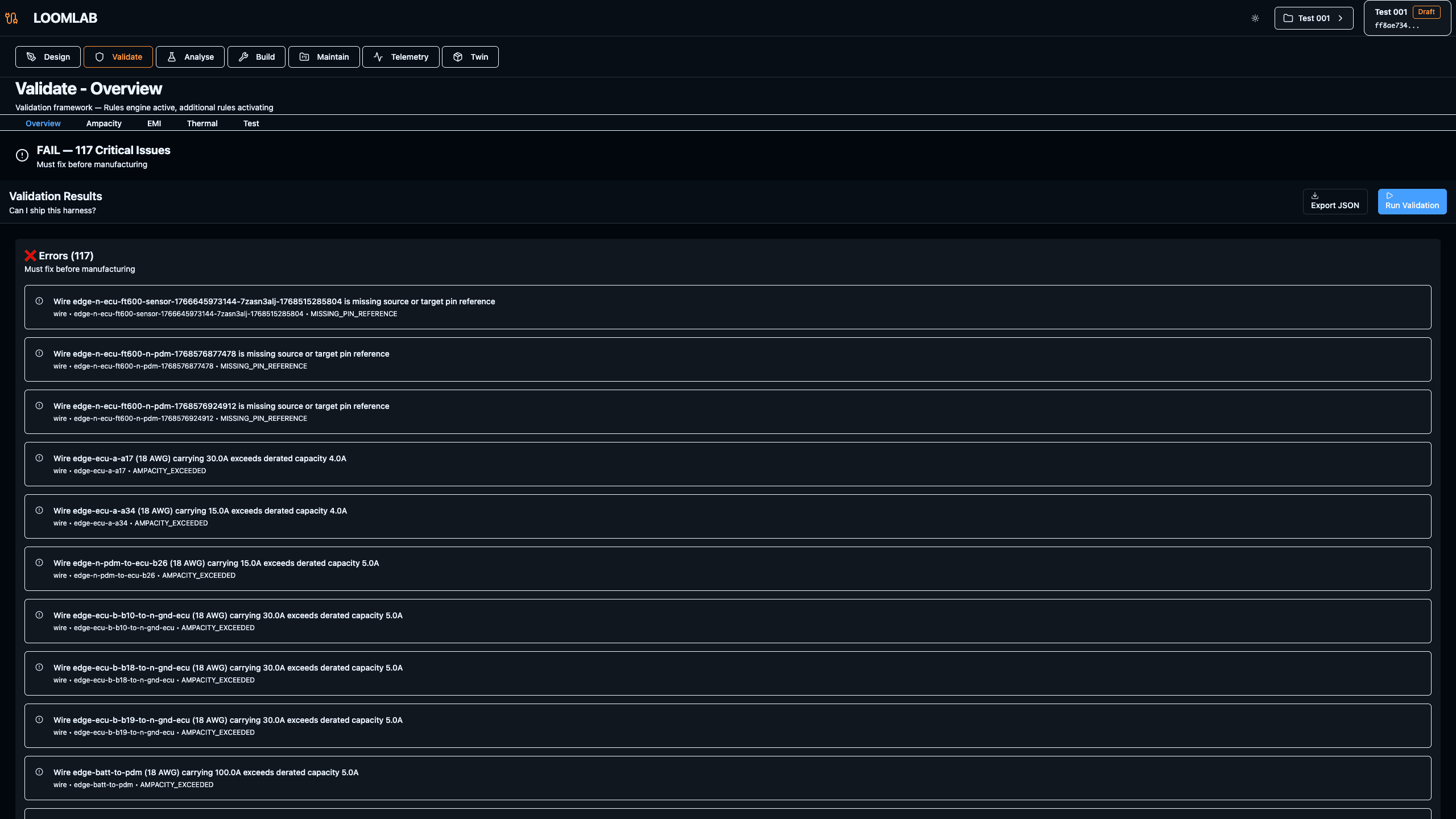
Validation checks electrical constraints directly from the design model—no export/import cycles, no manual re-entry. Ampacity, voltage drop, thermal limits, and EMI compliance are all computed from the same twin that defines components and nets. When you modify the design, validation updates automatically. This tight coupling ensures validation always reflects current design state, catches issues early, and keeps engineering feedback close to the model. The validation summary provides a system health overview, with detailed tabs for each constraint type.
Actions:
- →Navigate to /projects/[id]/validate
- →Review validation summary showing overall system health
- →Observe check status indicators (pass/warning/fail) for each constraint type
- →Understand that validation derives from the design model automatically
- →Note how validation updates when design changes
Expected Outcome: Validation overview showing system health with understanding that all checks derive from the design model
Interpret Warnings
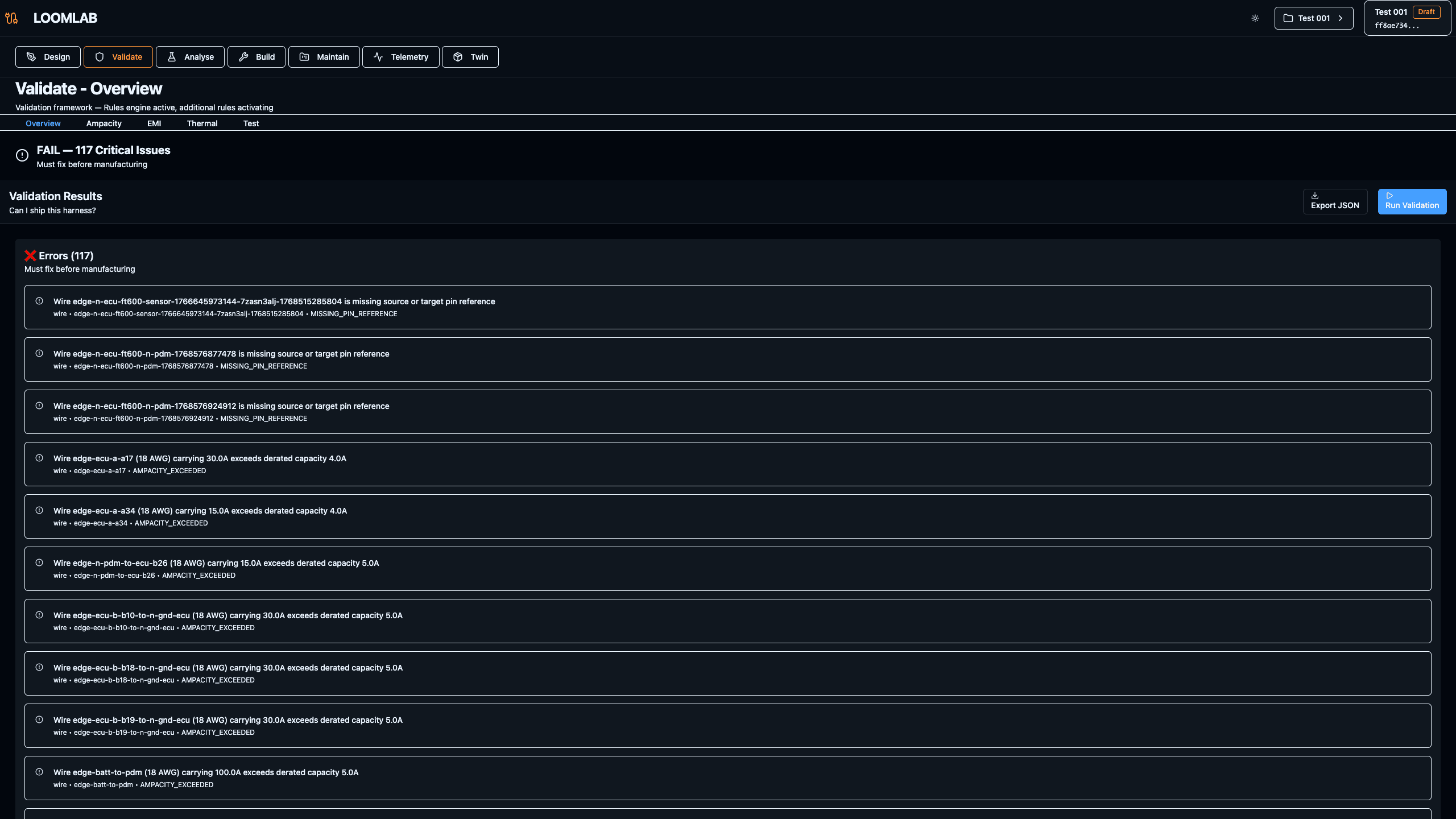
A safe warning state demonstrates how the twin flags issues early and keeps engineering feedback close to the model. Warnings guide improvements without blocking workflow.
Actions:
- →Review warnings in validation results
- →Understand difference between warnings and errors
- →Plan remediation strategy
Expected Outcome: Warning state showing recommended improvements
Ampacity Validation — Current-Carrying Capacity
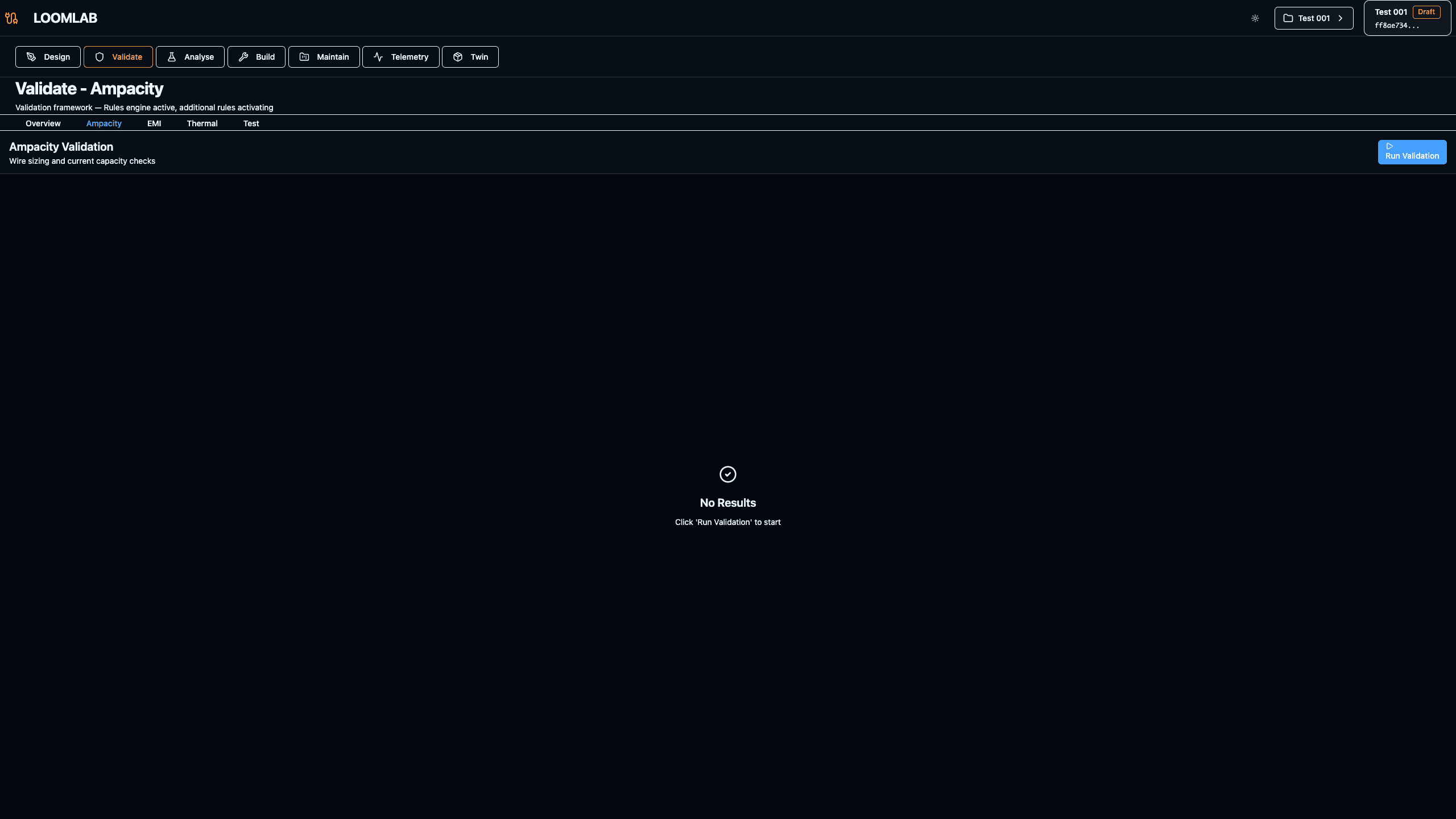
Ampacity validation ensures wires can safely carry their design current without overheating. The analysis considers wire gauge, ambient temperature, bundling effects, and insulation ratings—all defined in the model. Wires in bundles derate due to reduced heat dissipation, and the validation flags wires that exceed safe current limits. Recommendations include increasing wire gauge, reducing bundle size, or improving routing for better airflow. All calculations derive from the electrical model, ensuring consistency between design intent and validation results.
Actions:
- →Navigate to Ampacity tab in Validate page
- →Review wire-by-wire ampacity calculations
- →Understand bundling derating factors and thermal assumptions
- →Identify wires exceeding safe current limits
- →Review recommendations for gauge increases or routing changes
Expected Outcome: Ampacity validation showing per-wire current capacity, derating factors, and safety margins
EMI Validation — Electromagnetic Interference
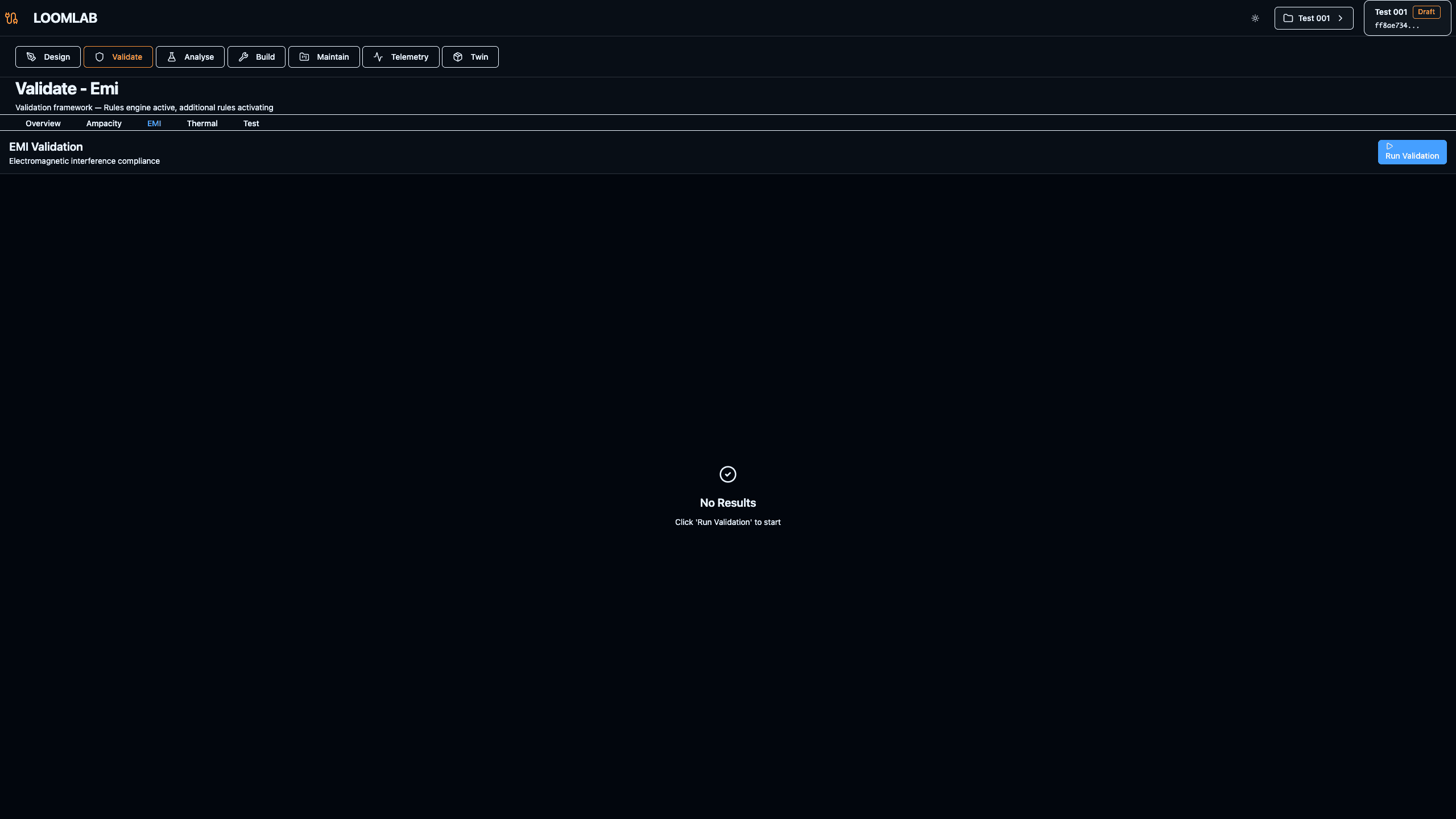
EMI validation checks that signal integrity is maintained and electromagnetic emissions comply with standards. Differential pairs (CAN_H/CAN_L) must maintain proper spacing and routing to reject common-mode noise. Power and signal wires must be separated to prevent coupling. The validation flags nets that violate EMI constraints, such as high-speed signals routed too close to power lines or improper differential pair routing. EMI rules are attached to nets and components in the model, making constraints computable and traceable.
Actions:
- →Navigate to EMI tab in Validate page
- →Review EMI constraint violations and compliance status
- →Understand differential pair routing requirements
- →Identify nets requiring improved separation or shielding
- →Review EMI rules attached to nets and components
Expected Outcome: EMI validation showing constraint violations, compliance status, and routing recommendations